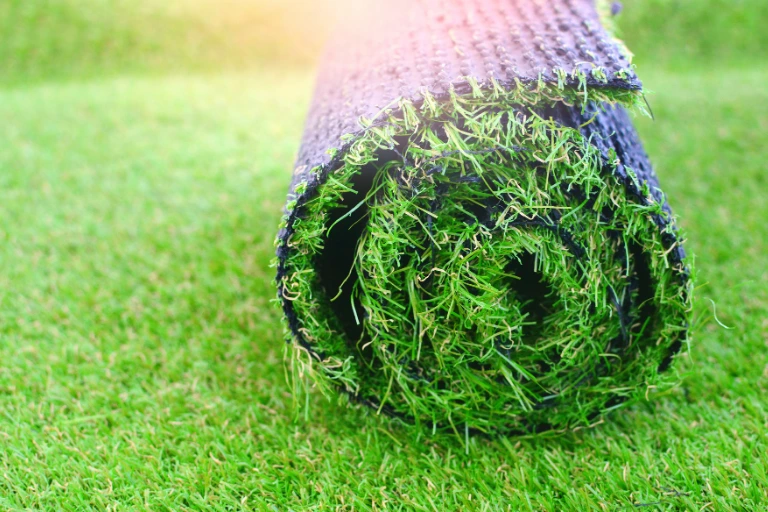
There is no single best artificial grass for the UAE. The best product is the one matched to three things: the surface it will sit on, how much direct sun the area gets, and how hard it will be used. A soft, tall lawn that suits a shaded villa garden can be the wrong choice for a south-facing rooftop or a dog run.
This guide explains how to choose. It covers the specifications worth reading on a data sheet, what to expect from summer heat, why drainage starts below the grass, which infill to use, and how to read a warranty before you sign.
Quick Answer
What is the best artificial grass for UAE homes?
Choose a UV-stabilised product whose pile height, fibre thickness and density suit how the area is used, install it on a base prepared for that surface (soil, concrete, tiles or rooftop), and get the manufacturer’s warranty and the installer’s workmanship warranty in writing. In full sun, plan shade or timed use, because every artificial grass gets hot.
Start With the Space, Not the Sample
It is easy to choose grass by how it feels in a showroom and miss what the area needs. Decide what the space requires first, then shortlist products that meet it.
| Area | Main priority | What to check |
|---|---|---|
| Villa garden on soil | Natural appearance and long-term drainage | Excavation depth, sub-base compaction, weed membrane, edge restraint |
| Balcony or rooftop | Drainage routing and building approval | Drainage outlets kept clear, added weight of infill, building or community rules |
| Children’s play area | Comfort and an even surface | A shock pad rated for the fall height of any play equipment, shade for summer use |
| Pet area | Drainage and hygiene | Permeable base, shorter pile, odour-control infill option, a hose point nearby |
| Commercial frontage or terrace | Wear resistance and safety | Thicker, denser fibre, securely fixed seams and edges, a maintenance plan |
Families with young children and pets have extra questions about safety and hygiene. Our guide to artificial grass for children and pets in the UAE covers them in more detail.
The Specifications Worth Reading on a Data Sheet
Two products can look alike on the roll and perform very differently after a UAE summer. Ask every supplier for the technical data sheet of the exact product quoted, and compare these points.
| Specification | What it means | How it affects your choice |
|---|---|---|
| Pile height (mm) | The length of the blades from the top of the backing to their tips | Taller pile looks fuller. Shorter pile is usually chosen for heavy use and pet areas. |
| Dtex | Yarn weight in grams per 10,000 metres. A higher number means a thicker fibre. | Thicker fibres wear better and stand up more firmly but feel stiffer. Home lawns rarely need sports-grade dtex. |
| Gauge and stitch rate | Gauge is the spacing between stitch rows. Stitch rate is the number of stitches per 10 cm. Together they give tufts per m². | Denser grass looks fuller and hides the backing, but uses more material and costs more. |
| Backing and drainage | The layer the fibres are tufted into, with drainage holes or a permeable construction | The backing lets water through. Whether it then drains away depends on the base underneath. |
| UV stabilisation | Treatment of the yarn to resist fading and breakdown in sunlight | Essential in UAE sun. Check what the UV warranty covers, for how long and on what conditions. |
The dtex definition follows Mondo’s explainer on what dtex means in artificial turf. Judge colour and blade shape from real samples outdoors in daylight, where the grass will be seen once it is installed.
How Hot Does Artificial Grass Get in UAE Sun?
Hot enough that you should plan for it before you buy. Researchers at Penn State’s Center for Sports Surface Research recorded synthetic turf surfaces of roughly 48°C to 71°C on summer days when the air temperature was only about 25 to 31°C (Penn State study). Those were sports surfaces in a far milder climate than a UAE summer, so treat them as a guide to the problem rather than a prediction for your garden.
Watering cools the surface, but only briefly. A fact sheet from the New York State Department of Health describes a Brigham Young University test in which a watered synthetic field heated up again within minutes (NYSDOH synthetic turf fact sheet). The same Penn State study found that adding calcined clay to the infill did not lower the surface temperature.
What makes a difference:
- Shade: trees, pergolas or shade sails over the parts of the lawn used most, especially play areas.
- Timing: plan barefoot use for mornings, evenings and the cooler months.
- A quick rinse: short-term relief before use, not a cooling system.
- Reflected sunlight: glass doors and windows can concentrate sunlight onto the grass and melt the fibres. TigerTurf lists melting caused by sun magnification through low-E windows among its warranty exclusions, so check for reflective glass facing the area before you install.
Some products are sold with heat-reduction claims. Ask for the test method and results behind the claim before paying more for it.
Drainage Starts Below the Grass
Drainage holes in the backing only move water down. Where it goes next depends on the base. Using the same preparation on every surface is a common reason for pooling water, ripples, and lifting edges.
| Base | Typical preparation | Risk if it is skipped |
|---|---|---|
| Natural soil | Remove existing turf and topsoil, lay and compact a free-draining aggregate sub-base, add a weed membrane, then lay, join and infill the grass | Sinking, uneven areas and standing water |
| Concrete | Check falls and drains, clean the surface, add an underlay or shock pad where comfort or drainage needs it, then fix the grass | Water trapped under the grass in low spots |
| Existing tiles or paving | Confirm the product’s installation guidance allows it, check that the tiles are sound and water can escape, then fix as for concrete | Loose tiles showing through and poor drainage |
| Balcony or rooftop | Confirm approval, keep every drainage outlet accessible, choose a build-up that suits the permitted load | Blocked outlets, water ingress and disputes with building management |
TigerTurf notes that a sound concrete pad can take artificial grass with little base preparation, while a soil installation needs a sub-base that drains well (TigerTurf FAQs). For apartments and towers, check with building management or the community before ordering, as balcony and rooftop works may need their approval.
Choosing an Infill: Sand, Zeolite or Rubber
Infill is the granular material brushed between the fibres. It adds weight, helps the blades stand upright, and protects the backing. Skipping it or under-filling it can leave the grass flattened and creased.
- Silica sand: the standard choice for most home lawns. TigerTurf recommends infilling its landscape grass with the correct specification and quantity of sand (TigerTurf FAQs).
- Zeolite: a mineral infill sold for pet areas. Manufacturers such as Easigrass say its negative charge absorbs ammonia from urine and reduces odour (Easigrass EasiZEO). It works alongside regular rinsing, not instead of it.
- Rubber crumb: mainly used on sports pitches. In 2023, the European Commission adopted a restriction on intentionally added microplastics that ends the sale of this type of infill in the EU after an eight-year transition (European Rubber Journal). The rule does not apply in the UAE, but it is a sign of where the industry is heading, and most home lawns do not need rubber infill.
How to Read an Artificial Grass Warranty
“Ten-year warranty” can mean very different things. There are usually two separate warranties, and you need both in writing.
- The manufacturer’s product warranty often focuses on UV stability. TigerTurf states that its landscape grass warranty covers UV stability only and does not cover faults caused by incorrect installation (TigerTurf FAQs).
- The installer’s workmanship warranty covers how the grass was laid: seams, edges, levels and drainage.
Product warranties also commonly exclude matting, misuse, fire, and window-reflection melting, and some are prorated so that cover reduces over time (TigerTurf US warranty terms). A warranty length shows the manufacturer’s confidence in the yarn. It is not a promise of how long the lawn will look new, which depends on sun, foot traffic, and care.
Common Mistakes When Buying Artificial Grass in the UAE
- Comparing a supply-only price with an installed price. Check whether each quote includes excavation, sub-base, membrane, edging, infill, and waste removal.
- Choosing from a photo. Ask for the data sheet and look at a sample in daylight.
- Ignoring the base. The grass cannot fix poor drainage or an uneven surface underneath.
- Believing that grass stays cool. Plan shade for areas used in summer.
- Installing on a balcony without approval. Removing grass later costs more than asking first.
- Accepting one warranty as “the warranty”. Ask which warranty covers the product and which covers the installation.
Related reading
See how we assess the base, sun exposure and drainage before recommending a product, and what our installation process includes.
Looking After Artificial Grass in the UAE
Artificial grass needs less care than a natural lawn, but it is not maintenance-free (TigerTurf FAQs). Dust, sand and leaves settle into the fibres, and pet areas need regular rinsing.
- Brush the fibres against the grain regularly to keep them upright, more often in high-traffic areas.
- Clear leaves with a plastic rake or leaf blower. Do not vacuum, as it removes the infill.
- Rinse off dust, particularly after sandstorms.
- Rinse pet areas often and remove solid waste promptly.
- Keep barbecues, fire pits, cigarettes and very hot objects off the grass.
- Top up infill where the fibres start to lie flat.
For layout ideas, edging and combining grass with planting, see our artificial grass landscaping tips.
Artificial Grass and Water Use in the UAE
The UAE Water Security Strategy 2036 targets a 21% reduction in total water demand. Replacing an irrigated lawn with artificial grass removes the lawn’s irrigation need, which is one reason many property owners consider it.
It is still a plastic product. It needs occasional rinsing, gets hot in direct sun, and will need disposal at the end of its life. Many gardens work best with artificial grass where people walk and play, and shade trees and drought-tolerant planting elsewhere. Our landscape design and build service plans both together. If you are choosing materials for a terrace or pool surround as well, our guide to outdoor decking for the UAE climate covers the same heat and sun questions.
Frequently Asked Questions
Can artificial grass be laid on tiles or concrete?
Often yes, if the surface is sound, water can drain away, and the product’s installation guidance allows it. Check the falls and drainage outlets first.
Which pile height is best for a UAE garden?
There is no single right height. A taller pile looks fuller in low-traffic gardens, while a shorter pile is usually preferred for pets, play and heavy use. Compare real samples of the products you are considering.
Will artificial grass fade in the UAE?
UV-stabilised yarn is designed to resist fading. Ask how long the manufacturer’s UV warranty lasts and what it defines as a failure.
How long does artificial grass last?
It depends on the product, UV exposure, foot traffic, and maintenance. Ask your installer for an estimate for the specific product and area, and read the warranty terms alongside it.
Not Sure Which Grass Suits Your Space?
Get advice based on your base, sun, and use.
Book a free site visit. We will check the surface and drainage, bring samples, and confirm pricing in writing after the visit.