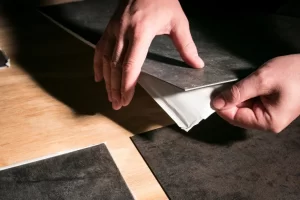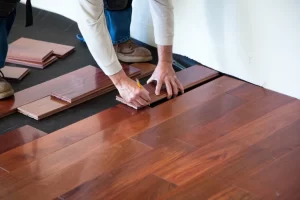
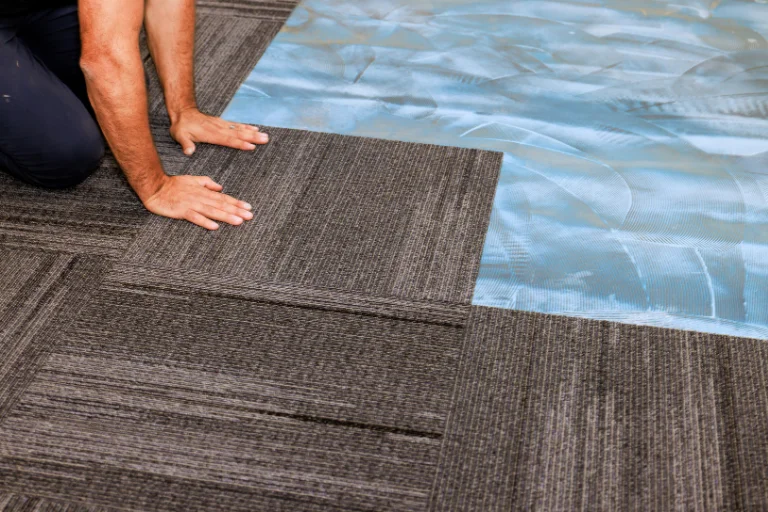
Carpet tiles are modular carpet squares or planks that fit together into a floor. For UAE offices, they work best where you need sound dampening, easy repairs, and access to underfloor cabling, because you can lift and replace single tiles. This guide covers how carpet tiles compare with broadloom, how to choose backing, fibre and pile, what installation involves, what drives the price and which questions to ask a supplier before you order.
Carpet tiles do not suit every room. Carpet struggles in wet areas, and busy entrances wear it faster than hard flooring, so we steer those spaces towards SPC flooring or LVT flooring
Where Carpet Tiles Work in an Office, and Where They Fall Short
The right floor depends on who specifies it and how the space gets used.
- Open-plan areas: Carpet absorbs sound that hard floors reflect, and tiles let you rework desk layouts or repair a worn path without relaying the floor.
- Meeting rooms and quiet zones: Cushion-backed tiles add underfoot comfort and reduce impact noise.
- Offices with underfloor cabling: You can lift tiles to reach the floor void and lay the same tiles back.
- Corridors: Loop pile or a directional plank layout can mark a walkway and hide light wear.
- Pantries and entrances: Spills, moisture, and tracked-in grit shorten carpet life, so choose a harder-wearing floor here.
They fall short in two places: wet areas and entrances that take heavy traffic and tracked-in grit. For those spaces, SPC flooring or LVT holds up better.
Explore more
Wet areas and busy entrances need a harder-wearing surface. Compare our SPC flooring and LVT options for those spaces.
Carpet Tiles vs Broadloom: Which Should You Specify?
Both formats have a place. The table compares them on the points that decide most commercial projects.
| Factor | Carpet tiles | Broadloom |
|---|---|---|
| Repairing damage | Replace only the affected tiles | Often needs a patch or a larger section replaced |
| Cutting waste | Lower, because tiles are cut mainly at the edges | Higher, shaped by roll width and room layout |
| Layout and pattern | Monolithic, quarter-turn, ashlar and mixed colours | Fewer pattern options within the roll |
| Seams | Grid lines can show if fitting is poor | Fewer visible seams, a continuous look |
| Underfloor access | Lift tiles to reach cabling | Needs cutting and refixing |
| Phased installation | Practical, section by section | Harder to phase |
| Upfront cost | Often higher per square metre than basic broadloom | Often lower for basic grades |
| Best suited to | Offices, meeting rooms and high-use commercial areas | Large uninterrupted spaces where a seamless finish matters |
Modular carpet also absorbs more structure-borne sound than hard flooring, and Milliken says it outperforms broadloom here too, which helps in large open-plan offices. The trade-off is appearance. Tiles show grid lines if fitters lay them badly, and a continuous broadloom finish can look more premium in a boardroom.
How to Choose Carpet Tiles: Backing, Fibre and Pile
Two tiles can look identical on a sample board and behave very differently once installed. Backing, fibre and pile construction decide how a tile performs in your space.
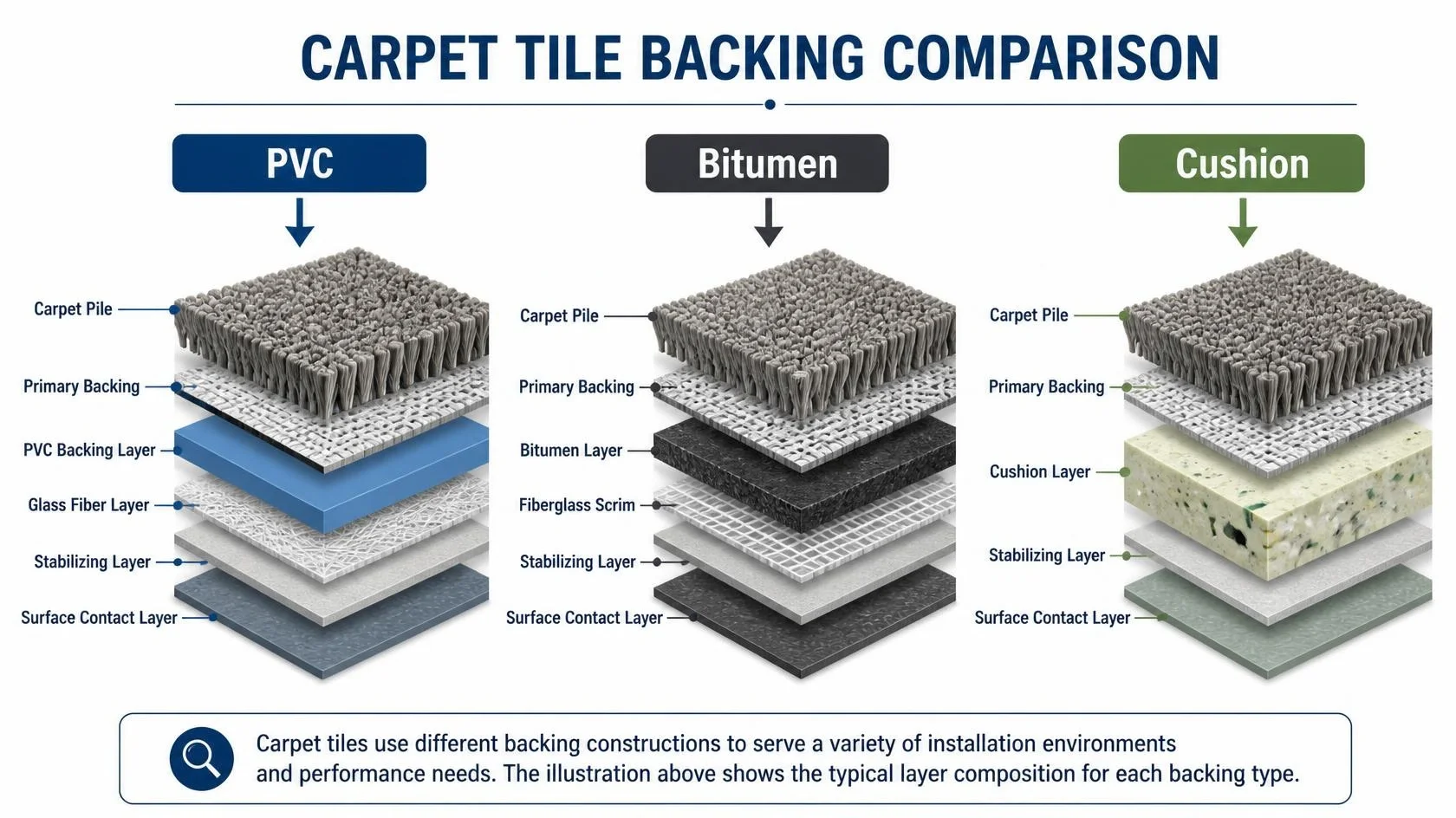
Carpet Tile Backing: PVC, Bitumen or Cushion
| Backing | What it offers | Best suited to |
|---|---|---|
| PVC, often fibreglass reinforced | Dimensional stability and good moisture tolerance | Offices, corridors and raised access floors |
| Bitumen | Weight and stability, with a long track record | Heavy-use areas kept away from pantries and entrances |
| Cushion (polyurethane or felt) | Underfoot comfort and better sound absorption | Meeting rooms, quiet zones, and areas where noise matters |
One commercial installer reports bitumen backing weakening near pantries and entrances after repeated moisture exposure. Our recommendation: choose backing by room, not by price. Fit PVC-backed tiles on raised access floors and in corridors, and consider cushion backing where noise matters most.
Fibre: Why Most Commercial Tiles Use Nylon
Nylon is the most common commercial fibre because it resists crushing, wear and staining well. Polypropylene resists moisture and soiling, which suits lighter-use areas. Solution-dyed yarn carries colour through the whole fibre instead of dyeing only the surface, so it is a common specification for commercial tiles.
Pile, Weight and Tile Size
Loop pile is common in corridors and open-plan areas, while cut pile tends to feel softer underfoot. Ask for pile weight in grams per square metre and for tuft density. Two tiles that look alike can carry very different amounts of yarn.
Common formats in the UAE market include 50 x 50 cm and 60 x 60 cm squares, plus plank tiles such as 25 x 100 cm. Squares suit a standard grid. Planks suit directional layouts and zoning, such as marking a walkway. We confirm the sizes available at the consultation stage.
Do Carpet Tiles Reduce Noise in an Office?
▲ Quick Answer
How are carpet tiles installed?
Installers fix carpet tiles with a releasable tackifier, full-spread adhesive or, in small rooms, corner tabs, over a clean, level, dry subfloor. Offices usually use tackifier, because individual tiles can still be lifted and replaced later.
Here is how an SPC Source carpet tile project runs:
- Consultation: We discuss the space, the traffic level, and whether tiles or another floor fits better.
- Site visit and measurement: Our team checks the subfloor, measures the area, and notes columns, doors, and fixed furniture that affect cutting.
- Product selection: We help you choose backing, pile, and layout pattern for how the space will be used.
- Proposal: You receive a clear proposal with materials and installation priced.
- Installation: Our own crew lays the tiles to the agreed pattern and direction, with no subcontractors.
- Quality inspection: We check alignment and edge fit as we go, and again at handover.
- Warranty and after-sales support: We back the work with warranty and after-sales service.
Installing Over Existing Ceramic or Stone Tile
Many UAE spaces already have ceramic or stone tile underfoot. Interface’s installation guidance says its releasable tabs can go directly over ceramic, marble, and stone with minimal preparation, as long as moisture and pH readings sit within limits. If readings run high, it recommends a barrier coat first.
We test before we lay, because carpet tiles cannot fix a moisture problem underneath.
Raised Access Floors and Underfloor Cabling
Offices with raised access floors usually specify PVC-backed tiles. A releasable tackifier bonds tiles to raised floor panels and still lets you lift them. When cabling needs attention, you lift the affected tiles, reach the floor void, and lay the same tiles back.
Carpet Tile Layout Patterns: Monolithic, Quarter-Turn and Ashlar
Every tile has an arrow on the back that shows pile direction. How fitters orient those arrows sets the look of the floor.
- Monolithic: All arrows point the same way, which gives a continuous, broadloom-style finish.
- Quarter-turn: Each tile turns 90 degrees from its neighbour, creating a checkerboard effect.
- Ashlar: Arrows point the same way, and each row sits half a tile along its length from the next, like brickwork.
We plan the direction and pattern before the first tile goes down, not partway through.
How Much Do Carpet Tiles Cost in Dubai?
▲ Quick Answer
How much do carpet tiles cost per square metre in Dubai?
Price per square metre depends on fibre, backing, pile weight, tile size, and project area. Basic and premium tiles sit far apart, so compare quotes on what they include. SPC Source confirms pricing after a free site visit, once we have measured the space.
A single price per square metre says little, because a basic nylon tile and a heavy cushion-backed tile solve different problems. Six factors move the price:
- Fibre and pile weight: More yarn and a higher-grade fibre raise the cost.
- Backing: Backing type affects both cost and performance.
- Tile size and pattern: Planks and complex layouts create more cutting.
- Area and order quantity: Larger orders can lower the rate per square metre.
- Subfloor condition: Levelling, moisture treatment and removing old flooring add to the project cost.
- Installation method: Tackifier, full-spread adhesive and tabs carry different material and labour needs.
When you compare quotes, check what each figure covers. Ask whether it includes installation, adhesive, edge trims, spare tiles from the same batch, delivery, and VAT. A lower price that leaves several of those out is rarely the cheaper project.
Maintenance, Replacement and How Long Carpet Tiles Last
Vacuuming is the most important part of any carpet tile maintenance plan, according to Interface’s maintenance guidelines. Clear spills quickly, and schedule periodic hot water extraction for deeper cleaning, with the frequency set by traffic. Entrance matting helps too, because it traps grit at the door before it reaches the carpet.
Replacing a Damaged Tile
Lift the damaged tile and fit a spare from the same batch. Dye lots vary between production runs, so tiles ordered later may not match the original. We recommend ordering a small surplus with your main order, and we confirm the quantity for your project.
![Before/after photo: one damaged tile replaced in an installed floor]](https://spcsource.com/wp-content/uploads/2026/10/Carpet-Tile-Backing-Comparison-1.webp)
How Long Do Carpet Tiles Last?
Commercial carpet is generally quoted at 7 to 15 years, depending on traffic, fibre quality, and maintenance. Tiles can stretch that range, because you can replace or rotate only the worn tiles instead of the whole floor.
Questions to Ask Any Carpet Tile Supplier Before You Order
Use this checklist to compare suppliers on facts rather than catalogue photos.
- Which backing does the tile use, and does it suit a raised access floor or a moisture-prone corridor?
- What are the pile weight and tuft density?
- Does the tile, and the adhesive, carry Green Label Plus certification? This independent Carpet and Rug Institute programme tests carpet, adhesive, and cushion for low VOC emissions.
- Can you supply spare tiles from the same batch, and for how long?
- What fire-test documentation comes with the product, and does it meet your building’s fit-out requirements?
- Does the quote include installation, adhesive, trims, delivery, and VAT?
- What does the warranty cover, in writing?
Why Fit-Out Teams and Property Owners Choose SPC Source for Carpet Tiles
Free site visit before you commit: We assess the subfloor and measure the space before recommending anything.
- Installed by our own crew: The team that visits your site installs the floor, with no subcontractors.
- Direction planned first: We confirm the pattern and tile direction before installation starts.
- Spare tiles from the same batch: Future replacements match the original floor.
- Seams checked as we go: We check alignment and edge fit during installation, not only at handover.
- Warranty and after-sales support: We back the work with warranty and after-sales service.
Discover more
Fitting out more than one floor type? Browse the full flooring range, from SPC and LVT to rubber and gym flooring.
If you are planning carpet tile installation in Dubai or anywhere in the UAE, send us the size and layout of your space. We will recommend the backing, pile, and pattern that fit how you will use it.
GET A QUOTE
Planning a carpet tile installation for your office or commercial space?
Tell us the size and layout and we will recommend the backing, pile, and pattern that suit how the space will be used, before anything is ordered.
✓ Free site visit ✓ Free quote ✓ WhatsApp or call, your choice