Outdoor decking in Dubai has to survive conditions most decking specs were never written for. Most advice written for the UK or the US simply doesn’t hold up here.
A board rated for 25 to 30 years of temperate rain and mild sun faces a different test altogether under a Dubai summer, where surface heat and UV exposure run higher for longer each year. Material choice and finish matter more here than in almost any other market.
Decking is also rarely the only decision in an outdoor project. If turf, planting, or a full layout redesign is part of the plan, that’s worth scoping alongside the decking material, not after it’s already chosen.
▲ Quick Answer
What is the best type of decking for outdoor use?
In the UAE, capped WPC composite and PVC composite decking generally outperform natural hardwood for most residential and commercial projects, since both resist rot, splintering, and insect damage without the sanding, oiling, and sealing timber needs in this climate. Natural hardwood still has a place where a specific grain and appearance is the priority, and the owner is prepared for the maintenance it requires.
WPC Outdoor Decking: What It Is and Why It’s the UAE Default
WPC stands for wood-plastic composite. Manufacturers bind wood fibres with polymer to make the boards, typically in a ratio weighted toward wood fibre content, with the exact split varying by manufacturer and product line.
The polymer encapsulates the wood fibre, which is what gives WPC its resistance to rot and insect damage compared with solid timber. Termites and other wood-boring insects can’t reach the wood fibre through the polymer shell the way they can with untreated solid timber, a significant practical advantage over hardwood in this region.
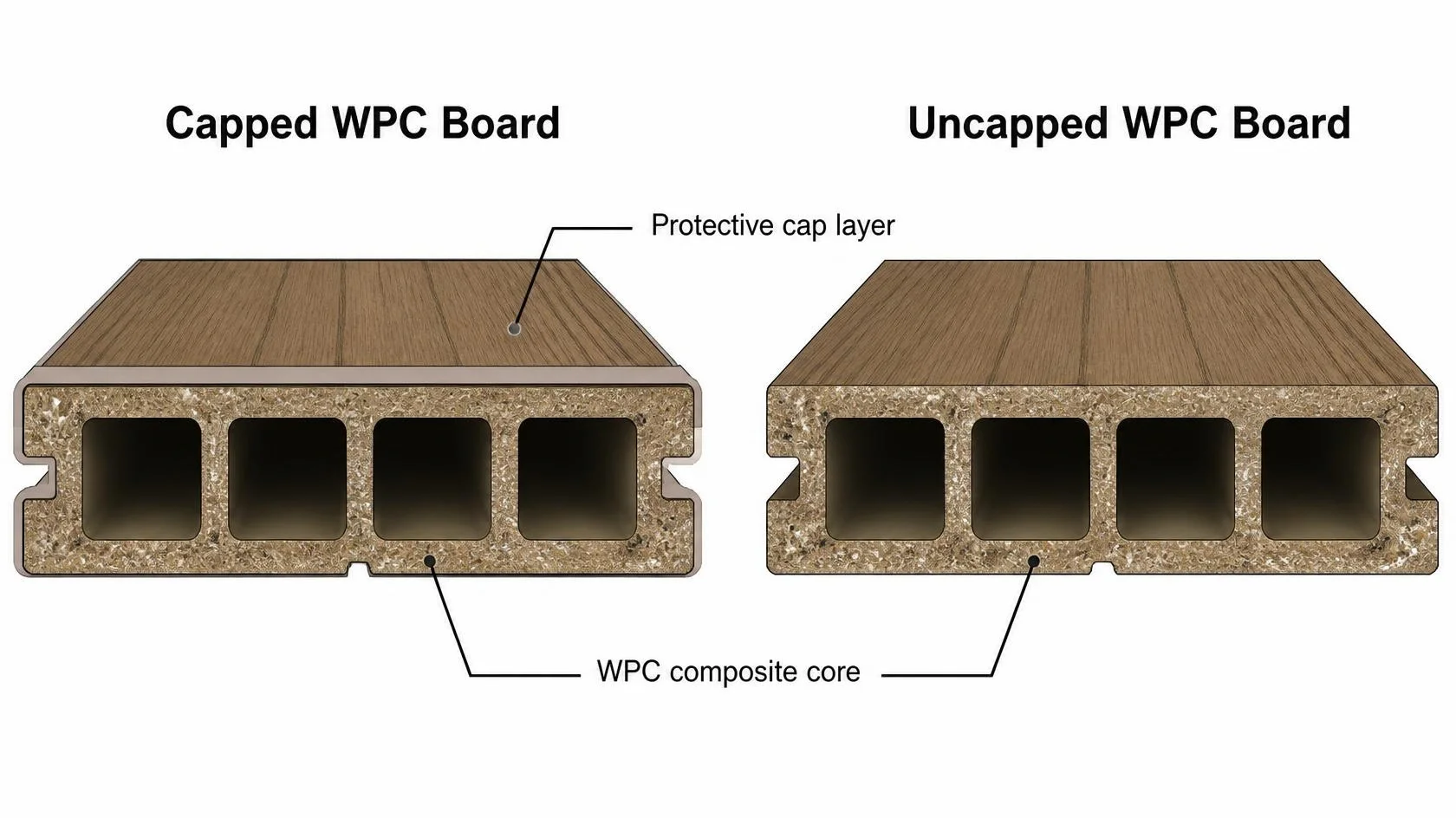
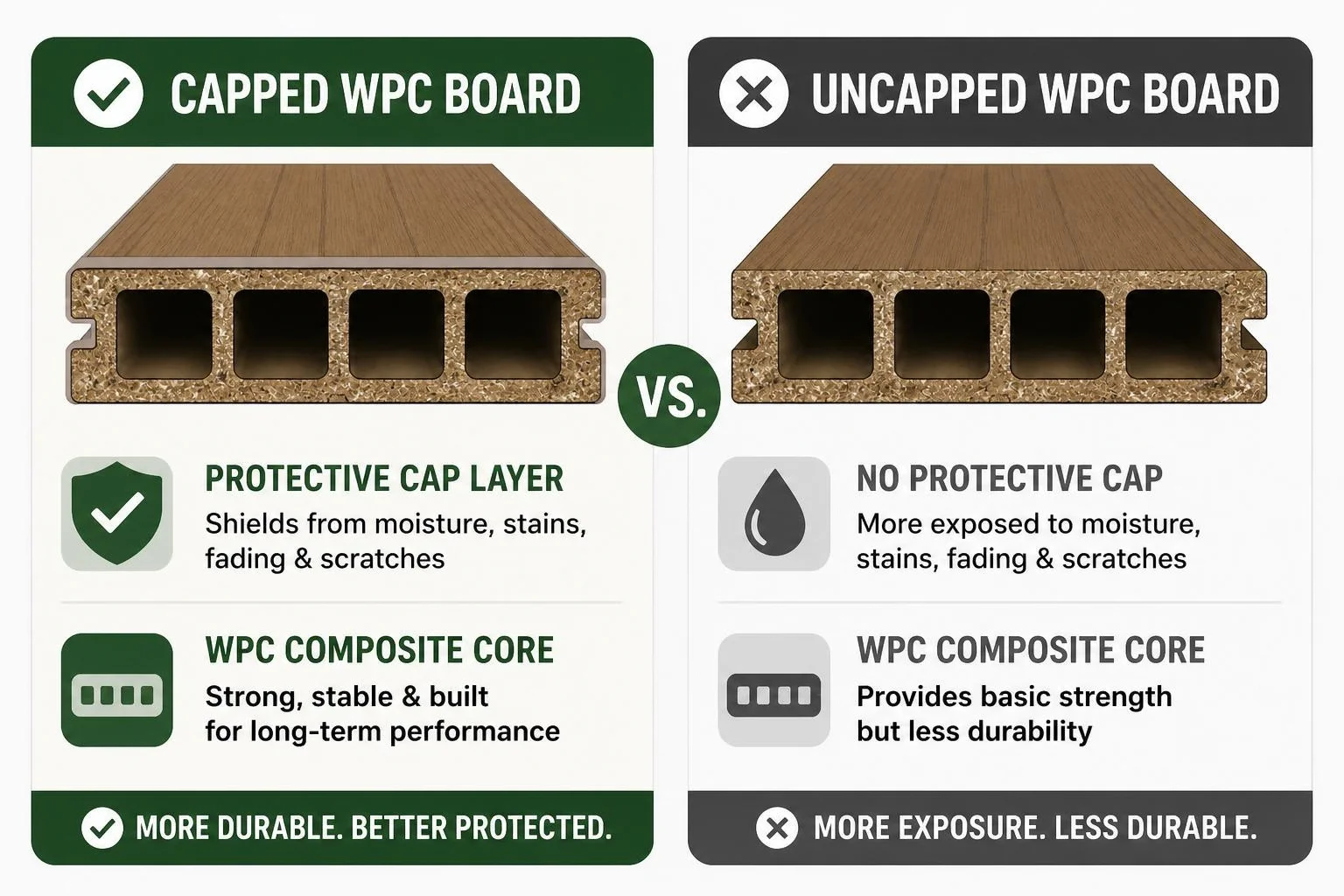
WPC isn’t built to one standard. Two build qualities matter most:
- Capped WPC — a protective polymer shell covers the core, meaningfully improving fade resistance and moisture performance over time.
- Uncapped WPC — the wood fibre sits closer to the surface, more exposed to UV and weather, and fades and wears faster as a result.
According to manufacturer performance data on capped composite construction, this build-quality distinction affects long-term fade and moisture resistance more than the general product category name does. When comparing products, it’s the distinction worth asking suppliers about directly.
 Waterproof outdoor decking: What “waterproof” Means
 Waterproof outdoor decking: What “waterproof” Means
WPC’s polymer content makes it substantially more water-resistant than solid timber, since the wood fibre is largely encapsulated rather than exposed. That’s different from an absolute waterproof claim.
Seams, cut edges, and fastener points are where water resistance is most tested in practice, so installation quality affects real-world performance as much as the material itself. A supplier should be able to confirm the specific water-resistance rating of the product being quoted, not just a general “waterproof” label. Poolside decking adds a slip-resistance requirement on top of this, covered in more detail on the service page linked below.
dISCOVER mORE
This same “moisture-resistant, not waterproof” distinction applies to WPC indoors too. See how it plays out for WPC wall panels in UAE interiors.
Which Type of Decking Is Best? Comparing the Main Options
“Best” depends on what the space needs to do. A poolside deck has different priorities than a shaded garden terrace, and a commercial entrance sees different traffic than a villa balcony. The table below compares the main categories of factors that actually matter for UAE conditions.
| Material | Heat & UV Performance | Water Resistance | Maintenance |
|---|---|---|---|
| Capped WPC / PVC composite | Strong with UV-stabilised capping; darker colours still get hot in direct sun | Good; polymer shell limits moisture ingress at the surface | Low — occasional cleaning, no sanding or sealing |
| Uncapped WPC composite | Moderate; more prone to fading and surface wear over time than capped product | Moderate; wood fibre nearer the surface is more exposed | Low to moderate |
| Natural hardwood (teak, ipe-type species) | Variable by species; without regular oiling, UV causes greying and surface checking | Good when well-maintained; poor if finish lapses | High — periodic oiling, sanding, and resealing |
For most UAE residential and commercial projects, this is why capped composite has become the practical default: it removes the maintenance cycle that hardwood genuinely needs to perform well in this climate, without the fading risk of uncapped composite.
Board format aside, every decking type sits on a substructure, typically timber or aluminium joists beneath the boards, and that substructure’s condition affects lifespan as much as the boards themselves do. Colour and finish choice matters too: darker tones absorb more heat and show dust faster in UAE conditions than lighter, matte finishes.
Outdoor Decking Boards: Which Format Fits Your Project
Outdoor decking boards are typically supplied in standard plank widths and lengths, with grooved or hollow-core profiles common in composite ranges to reduce weight and material cost without sacrificing structural performance. Solid-core boards are heavier and generally used where higher foot traffic or furniture load is expected, such as commercial terraces.
Board profile also affects installation: grooved edges typically pair with hidden fastener clips for a clean, screw-free surface finish, while some budget composite and most timber boards use face-fixed screws instead.
How Long Does Outdoor Decking Last?
▲ Quick Answer
How long does outdoor decking last?
Manufacturers commonly cite 25 to 30 years for standard capped composite decking and up to 40 to 50 years for premium capped or PVC products, though these figures generally come from testing in temperate climates. Dubai’s sustained summer heat and intense UV exposure place greater demands on a board than a UK or US install sees, so actual lifespan here depends heavily on capping quality, UV stabilisation grade, and installation, not the headline number alone.
Independent guidance on composite lifespan puts standard capped composite at 25 to 50 years depending on product tier and climate exposure, which lines up with manufacturer figures but underlines how wide that range is before climate is even factored in.
Natural hardwood decking typically needs replacing or substantially restoring within 10 to 15 years without consistent maintenance. That’s considerably sooner than composite, which is the main reason composite has become the default recommendation across the region rather than a marketing preference.
Outdoor Decking Installation: Why UAE Heat Changes the Process
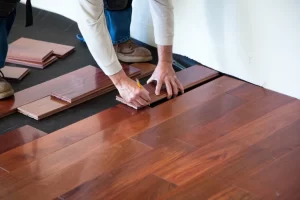
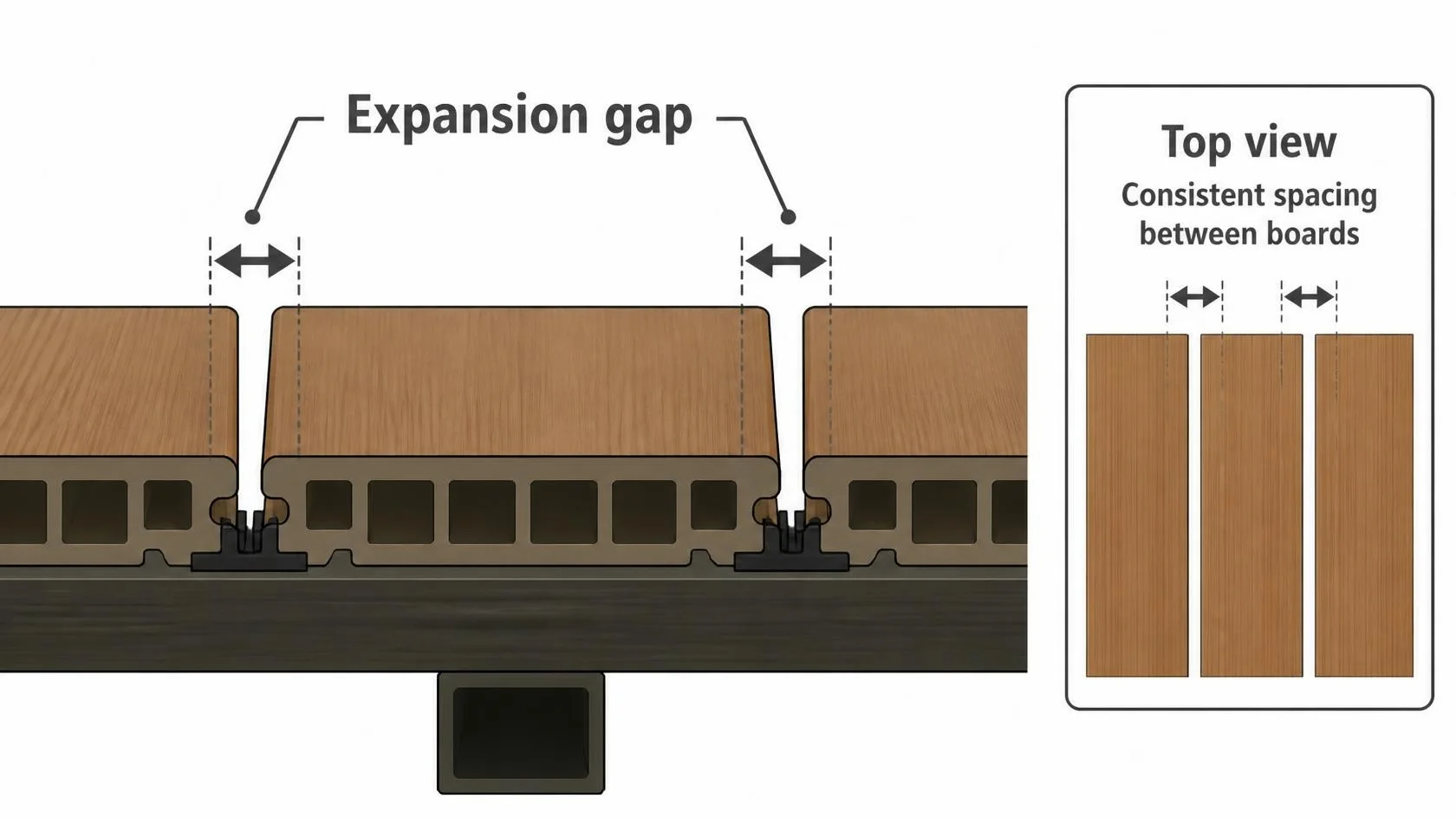
Composite and timber decking both expand and contract with temperature, and that movement is larger across Dubai’s heat range than what most decking specifications are written for. Installing boards with a standard, generic expansion gap, rather than one calculated for actual local temperature swings, is one of the most common causes of buckling or gapping after a single summer.
This is a site-specific calculation, not a fixed number that applies everywhere, which is why outdoor decking installation in the UAE is handled as part of the on-site process itself rather than as generic advice in this post.
Related reading
For the full detail on how SPC Source calculates expansion gap spacing for Dubai’s heat, and how pool-area decking specs differ from a shaded terrace, see the full Outdoor Decking solutions page.
Questions Worth Asking Before You Choose a Decking Supplier
- Is the product capped or uncapped, and what’s the UV-stabilisation grade?
- How is the expansion gap calculated: a fixed spec number, or your site’s actual sun exposure?
- What slip-resistance rating does the finish carry, especially for poolside areas?
- What does the substructure look like, and is it included in the quote?
Explore more
Decking is rarely the only piece of an outdoor project. If artificial turf or a full landscape redesign is also on the table, these cover the rest of the space.
GET A QUOTE
Not sure which decking material suits your space?
A poolside deck, a shaded terrace and a commercial entrance all call for different specs. Tell us about your space and we’ll recommend the right material, finish and spacing before anything is ordered.
✓ Free site visit ✓ No-obligation quote ✓ WhatsApp or call, your choice